
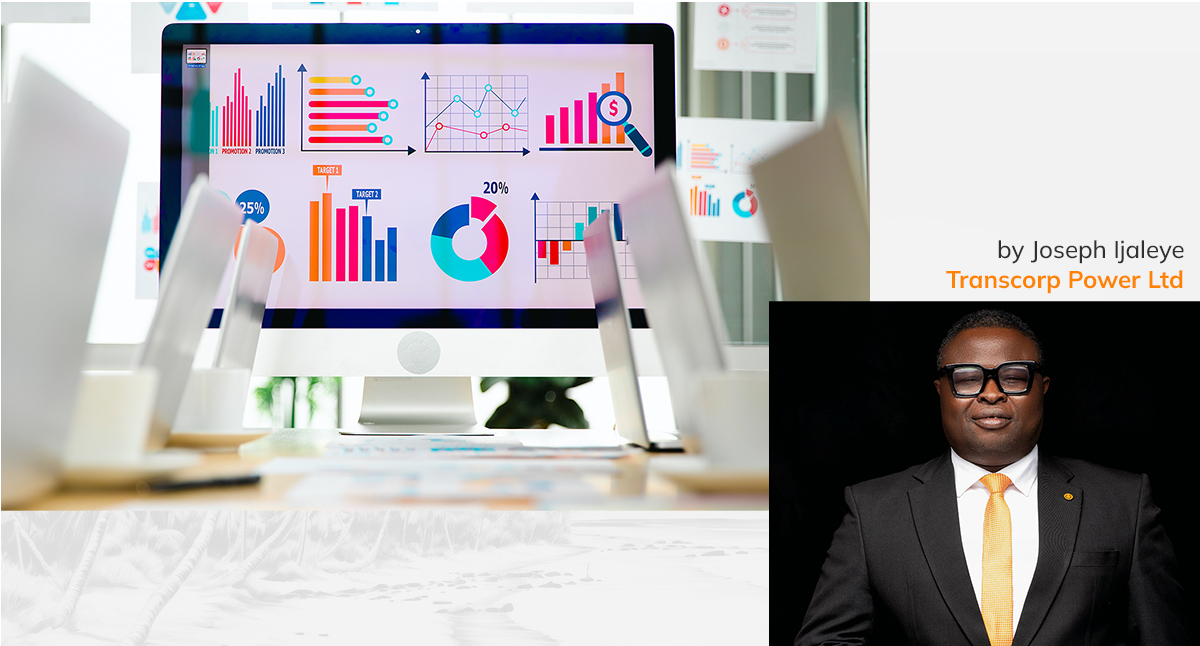
We are in a digital age, which has ushered in a new era where data reigns supreme, providing businesses with valuable insights into market trends and overall business performance as a key to making an informed business decision.
Data analytics is a game changer for business organizations, especially in the power industry. It helps business organizations increase efficiency and productivity by automating and streamlining processes, maximizing resource allocation, and reducing manual effort. It empowers decision-makers to make faster, better, more accurate, and more specific business decisions, as opposed to guesswork. Data analytics can help businesses predict future trends and outcomes, aiding in proactive decision-making and risk management. Hence, it is an indispensable tool for businesses that want to thrive in today’s data-driven, fast-paced business environment.
Fundamentally, data analytics entails the methodical analysis of unprocessed data with the aim of reaching useful conclusions. By adopting this strategy, companies are better able to obtain a detailed understanding of their operations, make data-driven decisions, correctly predict future trends, and ultimately promote growth and profitability.
Data analytics has had a significant impact on businesses across the globe and, more importantly, on the power business in several ways:
Grid Management: Data analytics helps in real-time monitoring of the power grid, enabling quick responses to outages and fluctuations. This enhances the reliability and resilience of the power supply. It is almost impossible in this age and time to have a reliable national grid without deploying robust analytical tools.
Energy Consumption Insights: Data analytics provides valuable insights into consumer behavior, helping power companies understand when and how electricity is used. This information can lead to better load forecasting and demand management.
Regulatory Compliance: Data analytics aids in compliance with government regulations in meeting the prescribed safety and health standards through effective tracking of emissions and other key metrics.
Operational Efficiency: Efficiency is key to power businesses, whether in power generation or distribution. Data analytics is used by power companies to optimize power generation and distribution, reducing waste and operational costs. Also, predictive maintenance using analytics can prevent equipment failures and minimize outages.
Risk Management: Analytics helps power companies in predicting, assessing, and mitigating risks. It can identify patterns that may signify fraud or operational weakness, allowing businesses to take preventative measures.
Competitive Advantage: Businesses that leverage data analytics often gain a competitive edge as they can anticipate market trends and customer needs better than their competitors.
Smart Grids: Data analytics is crucial to the development of smart grids because it allows communication between utilities and customers. This improves load management and energy usage efficiency.
The data analytics tools that are commonly used are Jupyter Notebook, Python, Apache Spark, Microsoft Power BI, Tableau, Qlik Sense, Looker, and SAS.
Data analytics has revolutionised the power industry by improving operational efficiency, reducing risk, managing the grid effectively and smartly, engaging customers, and offering valuable insight that spurs growth and innovation, ultimately leading to more sustainable and reliable power generation and supply.